New Labour Codes 2026: HR & Payroll Checklist for Employers in India
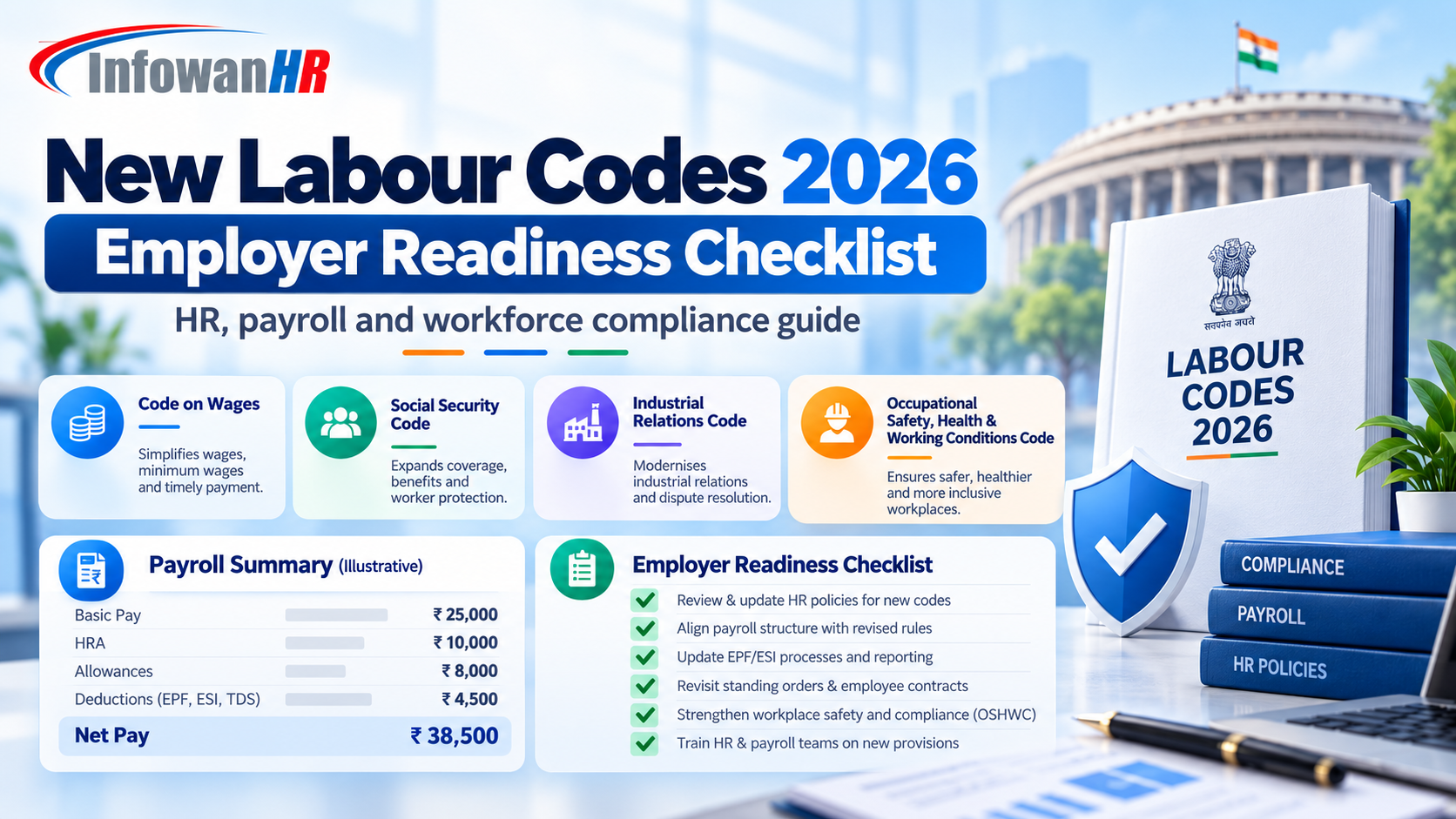
What should employers check under the new Labour Codes in 2026?
HR and payroll teams should review the wage definition and 50% allowance mechanism, salary-component mapping, gratuity, full-and-final settlement, overtime, attendance and working-time records, appointment documentation, employee classifications, social-security settings and state-specific rules. India's four Labour Codes took effect from 21 November 2025, so 2026 is the year many employers need to convert legal requirements into actual payroll and HR workflows.
Quick self-check: Is your HR/payroll setup ready?
- The four Labour Codes in plain HR language
- The 50% wage rule and salary structure
- Payroll, gratuity and statutory calculations
- Full & final settlement and overtime
- Attendance, appointment letters and records
- September 2026 EPFO update
- HR & payroll compliance checklist
- How an HRMS can support readiness
- Frequently asked questions
Your payroll can run successfully and still be configured incorrectly for a new compliance framework. That is the practical challenge facing HR teams in 2026.
The Government of India made the Code on Wages, 2019; Industrial Relations Code, 2020; Code on Social Security, 2020; and Occupational Safety, Health and Working Conditions Code, 2020 effective from 21 November 2025, consolidating 29 central labour laws. The HR question is no longer simply, “Have we read the Codes?†It is, “Have our salary structures, attendance records, payroll rules and employee workflows been checked against them?â€
The Four Labour Codes — in Plain HR Language
1. Start With the New Wage Definition — Not the Payslip Design
One of the most searched parts of the Labour Codes is the so-called “50% wage rule.†It is often simplified online as “Basic must be 50% of CTC.†That is not the most accurate way to understand the official rule.
Ministry FAQs explain that where specified allowances and benefits exceed 50% of remuneration, the excess is added back to wages for statutory purposes. The March 2026 additional FAQ also clarifies that overtime allowance forms part of the 50% calculation and explains how specified statutory components are treated.
What HR should audit
- Basic pay, DA and retaining allowance where applicable
- HRA and other allowances
- overtime payments
- employer PF/pension and statutory bonus treatment
- reimbursements and components that may sit outside the wage definition
- salary structures created years ago and never revisited
2. Re-Test Payroll, Gratuity and Fixed-Term Employee Rules
A wage-definition change can affect more than the visible payslip. Ministry FAQs state that the revised wage definition applies to gratuity from 21 November 2025. They also describe special treatment for fixed-term employees, including pro-rata gratuity in applicable cases and eligibility after one year under a fixed-term contract in the March 2026 clarification.
That means payroll teams should re-test calculations that depend on the statutory wage base rather than assuming last year's configuration remains correct.
Still checking wage structures employee-by-employee?
InfowanHR can help centralise salary structures, attendance, payroll and employee records so HR teams can audit workflows without stitching multiple files together.
3. Review Full & Final Settlement and Overtime Workflows
Section 17 of the Code on Wages provides that wages payable on resignation and certain other exits are to be paid within two working days, subject to the Code's qualifications and any different applicable time limit provided by the appropriate government.
For HR teams, the operational question is whether the exit process can move fast enough. If attendance lock, leave settlement, asset recovery, manager approval and payroll clearance still happen through email, the bottleneck may be the workflow rather than the calculation.
Overtime also deserves a clean data flow. Working-time and attendance records should support the applicable overtime calculation instead of forcing payroll to reconstruct hours at month-end.
4. Appointment Letters, Attendance and Employee Records Matter More
The Labour Ministry's official summaries identify appointment letters as part of the new framework. The Codes also extend or formalise protections around working conditions, social security and workforce categories.
That makes master-data quality more important. Employers should be able to identify an employee's joining date, employment category, location, entity, salary structure, shift/attendance rules and core documents without searching five systems.
Employee master
- Date of joining
- employment category
- entity/location
- salary structure
- appointment/contract documents
Attendance & time
- Shift rules
- working hours
- overtime
- weekly offs
- leave and LOP
Payroll
- Earning components
- deductions
- statutory mapping
- salary revisions
- F&F calculations
Compliance records
- Policy acknowledgements
- approval history
- contractor/worker data where relevant
- state/entity configuration
- audit exports
5. September 2026 Update: EPFO Wage Ceiling Is Now ₹25,000
This is separate from the four Labour Codes, but it is one of the most important current payroll changes for employers. The Union Government announced that the statutory wage ceiling for mandatory EPFO coverage increased from ₹15,000 to ₹25,000 per month with effect from 17 September 2026.
Employers should review onboarding, employee eligibility, EPF/EPS/EDLI configuration and payroll testing for employees affected by the revised ceiling.
Labour Codes 2026: HR & Payroll Checklist
Payroll
- Review salary components against the wage definition
- test the 50% allowance/add-back logic
- review gratuity calculations
- validate overtime configuration
- test F&F workflow
- review EPFO settings after the September 2026 ceiling change
HR
- Verify appointment/employment documentation
- review fixed-term employee records
- review employee classifications
- check salary revision history
- update policies and employee communications where required
Attendance
- Review working-hour rules
- configure overtime correctly
- check weekly-off and shift policies
- ensure attendance feeds payroll without manual reconstruction
Compliance
- Confirm Central vs State applicability
- retain accessible employee/wage records
- review contractor and migrant-worker workflows where relevant
- document configuration changes and approvals
The 30-Minute HRMS Readiness Test
- Can payroll show which salary structures may be affected by the wage definition?
- Can attendance and overtime flow into payroll without Excel?
- Can HR identify fixed-term employees instantly?
- Can the system produce employee, wage and attendance records without manually combining files?
- Can rules vary by entity, location or employee category where needed?
How an HRMS Can Support Labour-Code Readiness
Software does not replace professional legal or payroll advice. What it can do is remove the manual work that makes compliance harder to execute consistently.
A connected HRMS can bring employee master → attendance → leave → payroll → statutory configuration → documents → reports → exit into one controlled flow. That reduces duplicate entry, makes policy changes easier to test and improves the audit trail when HR needs to explain how a number was calculated.
Preparing HR & payroll for the 2026 Labour Codes?
Show us your current attendance, salary and payroll workflow. InfowanHR can demonstrate how those processes can be connected in one HRMS.
Frequently Asked Questions
Is Your HRMS Ready for 2026 Payroll Compliance?
See how InfowanHR connects attendance, leave, payroll, employee records, ESS and HR workflows in one system — so compliance changes can be implemented with less manual reconciliation.